

In the last post, we looked at how some investment accounts offer tax advantages. Over time, taxes become one of your largest — and most overlooked — expenses. They quietly erode returns by siphoning off money that would otherwise keep compounding.
That’s why accounts like 401(k)s and IRAs matter so much. They aren’t just investment vehicles — they’re tax shields.
For working teens and college students, the Roth IRA unlocks a rare and powerful tax advantage. Here are the key points to know:
If you have earned income from a job, you can open a Roth IRA.
Interest from savings accounts or cash gifts don’t count — it must be job income.
Most working teens are in the 0% federal income tax bracket.
Even if federal taxes are withheld from your paycheck, they’re typically refunded in full when you file your tax return.
Roth IRA contributions are taxed once — during the year in which you earn the money.
After that, the money grows tax-free and can be withdrawn tax-free in retirement.
For teens and college students, that usually means the money is never taxed at all.
Not when it’s earned.
Not while it’s growing.
Not when it’s withdrawn later in life.
Small contributions early can matter more than large ones later.
Opening a Roth IRA in your mid-teens and contributing even $100 per month through your early 20s can fund a meaningful portion of retirement — before you ever earn a full-time salary.
A quick note for parents: Roth IRAs aren’t counted as student assets on the FAFSA, so having one doesn’t change financial aid eligibility.
An Example
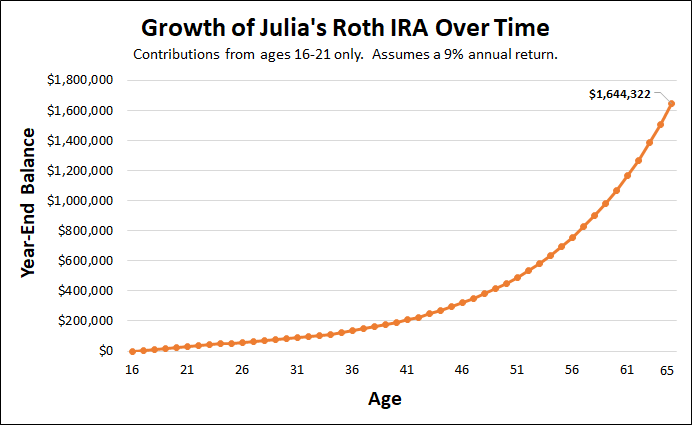
Julia starts working part-time at a grocery store at 16, earning about $6,000 per year. She invests $300 per month into a Roth IRA for two years, contributing a total of $7,200.
In college, she works more — a campus job during the year and waitressing in the summers — earning about $12,000 per year. She continues contributing to her Roth IRA, this time at $500 per month for four years, adding an additional $24,000.
By age 22, Julia has contributed $31,200 to her Roth IRA. Now let’s see how it grows with no additional contributions.
The Takeaway
When a teen earns income in the 0% tax bracket, a Roth IRA allows them to avoid taxes on that money — and its growth — for life. Even modest contributions made early can grow into something meaningful without requiring perfect timing, large deposits, or financial expertise.
If your teen has a job, opening a Roth IRA is one of the simplest ways to give them a financial head start. Time will do the rest.
If you want the details we didn’t cover here, I’ve laid them out in a separate post:
Roth IRA and the 0% Tax Bracket
In the next post, we’ll discuss how to open and fund a Roth IRA.