

There’s a simple formula that lets you estimate how long it takes for your money to double.
No calculator required.
72 ÷ your annual return ≈ years to double your money
That’s the Rule of 72.
An Example
Let’s say you have $10,000 invested.
If you expect a 9% annual return, the Rule of 72 says your money will double in approximately:
72 ÷ 9 = 8 years
So:
After 8 years → $20,000
After 16 years → $40,000
After 24 years → $80,000
How Accurate Is the Estimate?
Without going too deep into the math, the actual compound growth formula is:
FV = PV × (1 + r)ⁿ
Where:
PV = present value (starting amount)
FV = future value (ending amount)
r = annual return (written as a decimal)
n = number of years
If you want your money to double, then:
FV ÷ PV = 2
Which means:
(1 + r)ⁿ = 2
The Rule of 72 says that at a 9% return:
72 ÷ 9 = 8 years
Plugging that into the actual formula:
(1 + 0.09)⁸ = 1.993
That’s very close to 2. In this case, the Rule of 72 underestimates the exact doubling time — but it’s impressively accurate for a formula you can do in your head.
And given that real-world investment returns are never perfectly steady anyway, it’s more than accurate enough for planning purposes.
Additional Examples
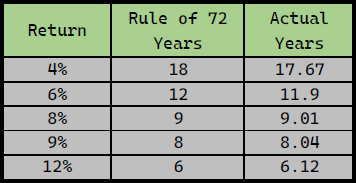
The chart above shows several returns and compares the estimated doubling time to the actual value.
As you can see, the gap widens as returns get very low or very high — but for common long-term investment return values, the Rule of 72 holds up remarkably well.