

Your first job. You’re hired at $15 an hour, work 12 hours, do the math, and expect to see $180 on your paycheck. But when you get paid, the amount is noticeably lower. Let’s look at where the missing money went.
You start with gross pay - the total amount you earned. In this case, it’s 12 hours x $15/hour = $180.00.
A number of items are removed - or deducted - from your gross pay. After subtracting all deductions, the amount you’re left with is your net pay, also known as take-home pay.
Below is an example paystub to help walk through the common deductions.
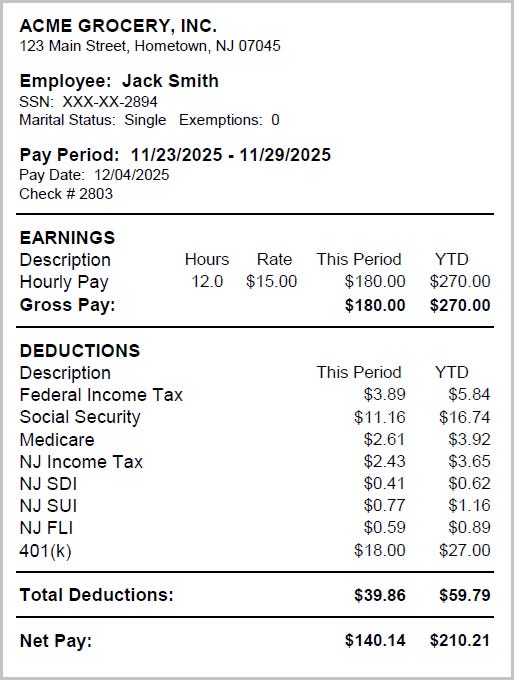
1. Federal income tax
A portion of every paycheck goes to the federal government. The amount depends on how much you earn and how you filled out your W-4 (a future topic). For many teenagers with part-time jobs, some or all of this amount may be refunded when you file taxes the following year.
2. Social Security (6.2%) and Medicare (1.45%)
Together these are called FICA taxes. Social Security provides income to retired Americans, and Medicare helps cover their medical costs.
3. State-specific taxes
Most states withhold money to pay for state programs and services. Nine states have no state income tax: AK, FL, NV, NH, SD, TN, TX, WA, WY.
Some states also withhold small amounts for things like disability insurance, unemployment insurance, and paid family leave. The example paystub is from New Jersey, which has all three (SDI, SUI, and FLI).
4. Benefits
If your job offers benefits such as health insurance or a 401(k), and you choose to participate, then your contributions often come out of your paycheck automatically. In the example, Jack contributes 10% of his pay to a 401(k) retirement plan. You’ll learn more about retirement savings in future posts.
5. Job-specific deductions
Depending on your job, you may pay for things like union dues, uniforms, or other job-related costs.
What’s a Pay Period?
Most jobs pay on a schedule called a pay period - weekly, biweekly, or twice a month are common. Your paycheck covers the hours you worked during that period, and payday usually comes a few days later, giving your employer time to total your hours and run payroll.
In the example, the pay period is November 23-29, a weekly period. Jack worked 12 hours during that week, and he was paid the following Thursday, December 4th.
What does YTD stand for?
Year-To-Date. It represents the total of all pay and deductions from January through this pay period. In this example, Jack worked 6 hours the week before, so the YTD amounts add last week’s paycheck to this week’s.